1

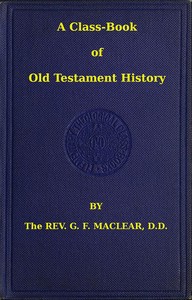
A Class-Book of Old Testament History — Reading Notes
(0 User reviews)
1252
Project Gutenberg
2020
Not confirmed
Bible. Old Testament -- History of Biblical events
Readers of public-domain and historical texts
Project Gutenberg digital edition
en
Edition facts
Words
169,260
Reading time
736 min
Text sections
32
Before opening A Class-Book of Old Testament History — Reading Notes, the edition data offers a quick orientation: 169,260 words, 12 hr 16 min estimated reading time, and 32 detected text sections.
The text analysis averages about 22.7 words per sentence, while the detected sections provide another way to judge how the source is divided.
Project Gutenberg metadata also associates the work with “Bible. Old Testament -- History of Biblical events,” connecting these edition facts with the source record’s subject description.
Source:
Project Gutenberg record #63528
Maclear's 1865 class-book presents Old Testament history through a pedagogical lens, emphasizing narrative pace and voice. The excerpt on Saul and Amalek shows his method: direct speech, moral commentary, and shifts from brisk action to reflective judgment.
Editorial Edition Score
4.9/5
★★★★★
★★★★★
Calculated from edition completeness, EPUB availability, text structure and catalogue metadata. Not a user rating.
How this score is calculated
- Description quality20 pts
- Title & short description10 pts
- Source metadata20 pts
- Text length15 pts
- Chapters / structure15 pts
- EPUB file integrity20 pts
Total of 100 points, scaled to a 2.5-5.0 range. Editions with an empty description or a missing EPUB file are not scored.
Edition quality
Public-domain source text
Read the source text
The source text is kept in the dedicated reader, separate from this catalogue record and its commentary.
Maclear's narrative voice in A Class-Book of Old Testament History is distinctly pedagogical, yet it avoids monotony by varying sentence rhythm and inserting moral commentary. The excerpt on Saul's campaign against Amalek illustrates this: brisk military action—'mustered a force of 210,000 at Telaim'—gives way to the prophet Samuel's stern rebuke, where the pace slows for direct speech: 'Jehovah had far more delight in obedience… than in burnt-offerings.' Maclear often uses such shifts to underscore divine judgment, as when the tearing of Samuel's mantle is interpreted as an omen. The prose is efficient, but not dry; it carries a quiet urgency in moments of crisis.
Shifts in Narrative Pace
Maclear modulates pace to signal importance. In the Amalek episode, the opening is swift: Saul's muster, the warning to Kenites, the attack 'from Havilah to Shur.' Then, at Samuel's arrival, the tempo drops. The bleating sheep and lowing oxen are described as revealing 'but too clearly the lax interpretation'—a pause for moral weight. Later, the execution of Agag is rendered in stark, almost ritualistic language: 'he hewed him in pieces before the Lord.' The contrast between rapid campaign summary and slow-motion judgment scene is deliberate, guiding the reader's attention to theological rather than military climax.
Direct Speech as a Tool of Characterization
Maclear uses quoted speech sparingly but to sharp effect. Saul's boastful greeting to Samuel—'he boasted of his execution of the Divine mandate'—is paraphrased, but the prophet's reply is given verbatim: 'As thy sword hath made women childless, so shall thy mother be childless among women.' This directness contrasts with the surrounding summary, making Samuel's voice authoritative and final. Agag's remark, 'surely the bitterness of death is past,' is also quoted, humanizing him briefly before his execution. These inserted voices break the teacherly tone and create dramatic immediacy.
Recurring Structural Patterns
The excerpt follows a pattern Maclear uses elsewhere: a divine command, human failure, prophetic confrontation, and symbolic action. The command to 'utterly destroy' is explicit; Saul's sparing of spoil and Agag is the failure; Samuel's confrontation includes the torn mantle as a symbol of the kingdom rent. Maclear then adds a coda: Samuel's sorrow and the new commission to anoint David. This three-part structure—command, transgression, consequence—recurs throughout the book, giving each episode a homiletic shape. The pattern is not rigid; Maclear varies the length of each phase, but the moral arc remains consistent.
Readers should attend to Maclear's use of parenthetical scripture references (e.g., '1 Sam. xv. 2, 3') not as interruptions but as invitations to compare his summary with the biblical text. His class-book is a précis, not a replacement; the gaps between his brisk narration and the original's fuller accounts reveal his interpretive choices. Noticing where he expands (as in Agag's execution) and where he compresses (as in Saul's muster) clarifies his pedagogical priorities.
That old class-book taught me how stories linger when told plainly, like someone’s voice you still hear after they’ve gone. There’s a quiet weight in its careful judgments, a patience I keep thinking about. I felt something similar reading Through lands that were dark Being a record of a year's missionary journey in Africa and Madagascar — A Reader’s Guide — not adventure, exactly, but the slow tenderness of watching a place change you.
There are no reviews for this eBook.
There are no comments for this eBook.
Reader reflection
Your personal reading reflection
Build a private reading journal entry for this title.
Your progress
0
/
10
2
How did the book work for you overall?
3
How likely are you to recommend this book?
4
How much effort did this book require?
5
Would you read this book again?
6
Did it raise ideas you would like to talk about?
7
How would you describe its reading pace?
8
How strongly did the book affect you emotionally?
9
What is the main idea you are taking away?
10