
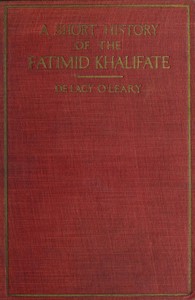
A Short History of the Fatimid Khalifate by De Lacy O'Leary
Ever feel like your mental map of the medieval world is missing a whole continent? A Short History of the Fatimid Khalifate by De Lacy O'Leary fills in one of the most fascinating blank spots. Forget the dusty, dry history tome—this book reads like someone uncovering a lost civilization in your own backyard.
The Story
This isn't a story with characters in the traditional sense, but the Fatimid Dynasty itself is the protagonist. It begins in the early 10th century with a man named Ubayd Allah, who claimed a revolutionary religious and political lineage. From a humble start in North Africa, he and his successors built an empire that stretched across the Mediterranean. Their crowning achievement was founding the city of Cairo as their glittering capital, a direct challenge to the power of Baghdad. For two centuries, the Fatimids weren't just rulers; they were patrons of incredible architecture, advanced sciences, and a library so vast it was legendary. But the book doesn't shy away from the drama—the family feuds, the military campaigns, and the gradual, complex decline that ended with their fall to the famous Salah ad-Din (Saladin). O'Leary walks you through this entire arc, showing not just what happened, but how it all fit together.
Why You Should Read It
I picked this up on a whim, and it genuinely shifted my perspective. We often get a very Europe-centric or Baghdad-centric view of this period. The Fatimids show there was a third, incredibly vibrant power player. O'Leary has a gift for explaining dense political and religious shifts without drowning you in jargon. You get a real sense of why their claim to leadership was so explosive and why their capital, Cairo, became a beacon. The most compelling part for me was seeing how their commitment to learning and culture directly shaped the world that came after them, even as their political rule ended.
Final Verdict
This book is perfect for history buffs who are tired of the same old medieval narratives and want to explore a side of the story they probably never learned in school. It's also great for anyone who enjoys a good 'rise and fall' saga, but prefers real history to fiction. Because it's a 'short history,' it's not an overwhelming commitment—it's more of a deep and fascinating afternoon dive. If you've ever wondered about the roots of Cairo or wanted to understand the complex chessboard of the medieval Middle East beyond the Crusades, O'Leary's classic work is your essential, and surprisingly engaging, starting point.
Legal analysis indicates this work is in the public domain. Distribute this work to help spread literacy.
William Miller
5 months agoInitially, I was looking for a specific answer, but it addresses the common misconceptions in a very professional manner. It’s hard to find this much value in a single source these days.
Donald Anderson
2 months agoGiven the current trends in this field, the structural organization allows for quick referencing of key points. The insights gained here are worth every minute of reading.
Jennifer Harris
9 months agoAfter spending a few days with this digital edition, the concise summaries at the end of each section are a lifesaver. Highly recommended for those seeking credible information.
Thomas Lopez
4 months agoGiven the current trends in this field, the author doesn't just scratch the surface but goes into meaningful detail. I’ll definitely be revisiting some of these chapters again soon.







Charles Perez
9 months agoUnlike many other resources I've purchased before, the transition between theoretical knowledge and practical application is seamless. I’ll definitely be revisiting some of these chapters again soon.