
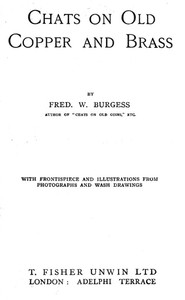
Chats on Old Copper and Brass by Fred. W. Burgess
Forget the idea that this is a stuffy academic catalog. 'Chats on Old Copper and Brass' is exactly what the title promises: a series of friendly, knowledgeable conversations. Burgess doesn't just list items and dates. He takes you by the hand and walks you through the entire world of domestic metalwork, from the grand chargers (those big decorative plates) in a Tudor hall down to the humble candlestick on a cottage table.
The Story
There isn't a traditional plot with characters. Instead, the 'story' is the journey of these metals through everyday life. Burgess explores how copper and brass were mined, worked by smiths, and used in homes for centuries. He talks about ale warmers, chocolate pots, fireplace equipment, and even medical 'quack' devices. He explains how to tell a piece made in 1650 from one made in 1750, not by memorizing dates, but by looking at the way the handle is attached or the style of the engraving. The narrative is the slow, fascinating evolution of craft and design, told through the objects people actually touched every day.
Why You Should Read It
This book completely changes how you look at the world. After reading it, you won't see an old, scratched brass bowl—you'll see an artifact. You'll wonder about the hands that polished it, the meals it held, and the conversations that happened around it. Burgess's passion is contagious. His writing is clear and full of a collector's genuine delight. He isn't showing off; he's sharing a secret language of shapes, marks, and materials. It makes history feel tangible and personal, not something locked away in a museum.
Final Verdict
Perfect for anyone with a curious mind who loves history, antiques, or just great storytelling about everyday things. If you've ever browsed a flea market and been curious about what you're looking at, this is your book. It's also a fantastic, calming read for anyone tired of fast-paced fiction; it’s a deep, slow dive into the beauty of craft and time. It’s not for someone seeking a thriller, but for the reader who wants to discover the quiet, fascinating stories etched in metal all around us.
This work has been identified as being free of known copyright restrictions. Thank you for supporting open literature.
Elizabeth Lopez
9 months agoThe clarity of the introduction set high expectations, and the author clearly has a deep mastery of the subject matter. The insights gained here are worth every minute of reading.
Barbara Smith
9 months agoOne of the most comprehensive guides I've read this year.
Jennifer Taylor
1 year agoIf you're tired of surface-level information, the inclusion of diverse viewpoints strengthens the overall narrative. I feel much more confident in my knowledge after finishing this.
George Lopez
10 months agoI've gone through the entire material twice now, and the bibliography and references suggest a high level of research and authority. The insights gained here are worth every minute of reading.




David Smith
1 month agoLooking at the bibliography alone, the way the author breaks down the core concepts is remarkably clear. This is a solid reference for both beginners and experts.