
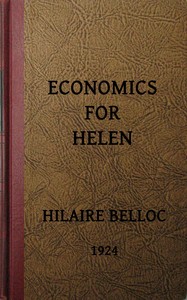
Economics for Helen by Hilaire Belloc
First published in 1924, Economics for Helen isn't a novel with a plot in the traditional sense. Think of it as a long, earnest, and sometimes fiery conversation. Belloc frames the book as a letter to a young woman named Helen, using this device to strip away academic jargon and get to what he sees as the heart of the matter.
The Story
The 'story' here is the story of property. Belloc starts with a simple idea: a healthy society is one where most people own productive property (like land or tools), which he calls the 'Distributive State.' He then walks Helen (and us) through history, arguing that this ideal was destroyed. He paints a picture of a small group (the 'Capitalists' or 'Plutocrats') using financial systems, interest, and rent to separate the majority of people from owning anything substantial. The result, he says, is the 'Servile State'—where most of us work for wages, forever dependent on a small owning class. It's a direct and dramatic argument about power, ownership, and freedom.
Why You Should Read It
You should read this not to get a balanced economics lesson, but to get a fiercely argued perspective. Belloc doesn't do neutral. His writing is clear, confident, and packed with conviction. Reading him is like listening to a brilliant, slightly cantankerous uncle explain the world over a strong cup of tea. He makes huge, sweeping claims that will make you stop and think, 'Wait, is that true?' Even when you disagree (and you likely will on some points), he forces you to question the basic assumptions of how money and ownership work. It's intellectually bracing.
Final Verdict
This book is perfect for readers who enjoy a good, old-fashioned argument and aren't afraid of a writer with a strong point of view. It's great for anyone curious about economic history, alternative political theories (like Distributism), or just wants to understand a foundational critique of modern capitalism that isn't Marxist. It's short, punchy, and written in plain English. Don't come looking for data charts or compromise; come ready for a passionate, provocative, and deeply personal take on who owns the world and why it might be a problem.
There are no legal restrictions on this material. Knowledge should be free and accessible.


Michael Taylor
1 month agoIt’s rare to find such a well-structured narrative nowadays, the visual layout and supporting data make the reading experience very smooth. I'll be recommending this to my students and colleagues alike.