1

Introduction to the textual criticism of the Greek New Testament — A Reader’s Guide
(0 User reviews)
361
Project Gutenberg
2025
Not confirmed
Bible. New Testament -- Criticism, Textual
Readers of public-domain and historical texts
Project Gutenberg digital edition
en
Edition facts
Words
121,384
Reading time
528 min
Text sections
30
The catalog record for Introduction to the textual criticism of the Greek New Testament — A Reader’s Guide provides practical reading context through 121,384 words, 8 hr 48 min estimated reading time, and 30 detected text sections.
The text analysis averages about 14.7 words per sentence, while the detected sections provide another way to judge how the source is divided.
Project Gutenberg metadata also associates the work with “Bible. New Testament -- Criticism, Textual,” connecting these edition facts with the source record’s subject description.
Source:
Project Gutenberg record #76224
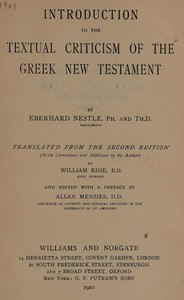
Eberhard Nestle's 1901 introduction to New Testament textual criticism, translated by William Edie and edited by Allan Menzies, examines manuscript evidence, variant readings, and the principles for evaluating witnesses, using specific examples like Codex Bezae and the Latin version h.
Editorial Edition Score
4.9/5
★★★★★
★★★★★
Calculated from edition completeness, EPUB availability, text structure and catalogue metadata. Not a user rating.
How this score is calculated
- Description quality20 pts
- Title & short description10 pts
- Source metadata20 pts
- Text length15 pts
- Chapters / structure15 pts
- EPUB file integrity20 pts
Total of 100 points, scaled to a 2.5-5.0 range. Editions with an empty description or a missing EPUB file are not scored.
Edition quality
Public-domain source text
Read the source text
The source text is kept in the dedicated reader, separate from this catalogue record and its commentary.
Eberhard Nestle, known for his work on the Greek New Testament and Syriac scholarship, opens this introduction by situating textual criticism as a discipline grounded in philological method. The volume, part of the Theological Translation Library, presents a translation of the second German edition with authorial corrections. Nestle’s approach is evident from the outset: he treats manuscript variants not as mere curiosities but as evidence requiring systematic evaluation. The editor’s preface, by Allan Menzies, highlights Nestle’s connections to English scholars and his role in proofreading major editions like Swete’s Septuagint. This context matters because Nestle’s own method—weighing internal and external evidence—is shaped by his engagement with both Continental and British textual traditions.
The Weight of a Single Witness
Nestle devotes considerable attention to the problem of evaluating readings supported by few manuscripts. He examines three variant readings from Codex Bezae (D) and the Latin version h: “bring the axe” (φέρε τὴν ἀξίνην) in Luke 13:7, “before you open your mouth” (ἀνοῖξαι τὸ στόμα) in Matthew 6:8, and “a basket of dung” (κόφινον κοπρίων) in Luke 13:8. He notes that Westcott and Hort, along with most recent editors, cite only the third reading, ignoring the first two. Nestle argues that the number of witnesses should not be the sole criterion: “the truth may have only one solitary representative left to support it against a whole world of adversaries.” He demonstrates that in Matthew 6:8, D is supported by h, a fourth- or fifth-century Latin manuscript, making it unlikely that h derives from D. This suggests an early, independent tradition for the reading. Nestle’s analysis shows how a single manuscript, when corroborated by a version or patristic quotation, can challenge the consensus of later editors.
The Bilingual Codex Bezae and Its Latin Counterpart
Nestle frequently returns to Codex Bezae (D), a bilingual Greek-Latin manuscript, and its Latin column (d). He uses the reading “a basket of dung” (κόφινον κοπρίων) to illustrate a methodological point: because d reads qualus rather than cophinus, the Greek text of D cannot be derived from the Latin. This counters a common objection against D’s Greek readings. Nestle also notes that Origen, in a Latin translation by Rufinus, appears to support “basket” (κόφινον), though Tischendorf had cited Origen for “dung” (κόπρια). Westcott and Hort, however, mention that Origen’s context supports κόφινον. Nestle thus presents a chain of evidence: D, eight Latin manuscripts, and a patristic quotation. He insists that editors should not dismiss readings simply because they appear in a “solitary Greek manuscript” when other witnesses align. The passage reveals Nestle’s commitment to tracing the history of each variant, weighing both internal probability and external attestation.
The Role of Conjecture and the Limits of Manuscript Evidence
Nestle acknowledges that textual criticism sometimes requires conjecture when no manuscript preserves the original reading. He states: “in certain circumstances the correct reading may no longer appear in any manuscript, but must be determined by conjecture.” This principle is embedded in his broader argument that the value of a reading does not depend solely on the number of its supporters. He contrasts this with the practice of Westcott and Hort, who often omit readings with weak attestation. Nestle’s own method is more inclusive: he believes that even a single witness, if it is early and independent, deserves consideration. He also emphasizes the importance of versions and patristic quotations as independent lines of evidence. The discussion of Codex Bezae and h shows how he reconstructs the transmission history to assess whether a reading is likely original or a scribal innovation. Nestle’s approach is cautious but open to the possibility that the truth may survive in unexpected places.
Readers should approach this introduction as a demonstration of method rather than a comprehensive handbook. Nestle’s focus on specific variants—particularly those from Codex Bezae—allows him to illustrate the reasoning behind textual decisions. The excerpts reveal a scholar who values both external evidence (manuscripts, versions, quotations) and internal criteria (style, context, transcriptional probability). Those new to the field will benefit from following his step-by-step analysis of each reading, while experienced critics may appreciate his challenges to prevailing editorial practices.
That wet Tuesday, I remember tracing Nestle’s account of Codex Bezae, the way its tangle of variants felt like rain smearing a windowpane. My margins filled with quiet arrows. Later, half-dreaming, I noticed the same impulse—to find the older shape beneath the words—pointing elsewhere, toward The Origin and Development of Christian Dogma: An essay in the science of history — Reading Notes. The room stayed grey, and I simply turned the page.
There are no reviews for this eBook.
There are no comments for this eBook.
Reader reflection
How did this book work for you?
Your answers remain private and are stored only in this browser.
Your progress
0
/
10
2
What was your overall reaction to the book?
3
Would you pass this book on to a friend?
4
Did the language feel accessible?
5
What was the strongest part of the book?
6
How did the pace of the book feel?
7
How did the reading compare with what you expected?
8
How understandable was the text?
9
Which lesson or insight stayed with you?
10