
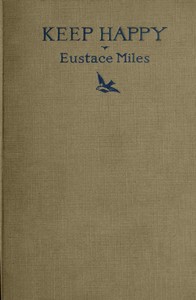
Keep Happy by Eustace Miles
Published in 1909, Keep Happy is less a story with a plot and more a friendly, persistent conversation with its author. Eustace Miles was a real character—a Cambridge scholar, a champion tennis player, and a man obsessed with health and diet. This book is his manifesto, a collection of his philosophies on how to live a joyful life.
The Story
There's no narrative in the traditional sense. Instead, Miles lays out his 'system' for happiness across short, punchy chapters. He starts with a simple, physical idea: our bad moods are literally shaped by our bodies. A frown, a clenched fist, shallow breathing—these aren't just symptoms of unhappiness; they're its cause. His core instruction is to practice 'curves': soften your eyes, relax your jaw, stand tall, and breathe deeply. He then applies this to the mind. 'Straight-line' thinking—worry, rigid opinions, forcing solutions—leads to strain. 'Curve' thinking—flexibility, open-mindedness, going with the flow—leads to peace. He fills the pages with practical exercises, anecdotes from his tennis career, and gentle challenges to the reader to try it for themselves.
Why You Should Read It
What's fascinating is how this century-old book accidentally speaks to our modern anxieties. Miles is essentially talking about mindfulness and somatic therapy long before they were mainstream terms. His advice to 'stop trying so hard' and 'let the game come to you' feels directly applicable to our burnout culture. It's not about ignoring problems, but about approaching them from a place of relaxed readiness instead of tense panic. His voice is the best part—earnest, encouraging, and completely convinced he's found the answer. You can almost see him grinning as he writes.
Final Verdict
This book is a hidden gem for anyone interested in the history of wellness, fans of quirky old manuals, or people who just need a gentle, unusual reminder to lighten up. It's not a scientific text, and some of his dietary ideas are very much of his time. But at its heart, Keep Happy is a timeless, charming pep talk. Perfect for the curious reader who enjoys a dose of history with their self-improvement, or anyone who needs permission to unclench their jaw and take a deep breath. It's a happy little artifact that still works.
This work has been identified as being free of known copyright restrictions. You are welcome to share this with anyone.
John Johnson
3 months agoInitially, I was looking for a specific answer, but the formatting on mobile devices is surprisingly crisp and clear. Top-tier content that deserves more recognition.
Karen Lopez
2 years agoI started reading this with a critical mind, the case studies and practical examples provided add immense value. Well worth the time invested in reading it.
Patricia Smith
3 months agoHaving followed this topic for years, I can say that the attention to detail regarding the core terminology is flawless. A refreshing and intellectually stimulating read.
Kimberly Miller
1 year agoGiven the current trends in this field, the footnotes provide extra depth for those who want to dig deeper. A solid investment for anyone's personal development.






Matthew Martin
3 months agoInitially, I was looking for a specific answer, but the data points used to support the main thesis are quite robust. I feel much more confident in my knowledge after finishing this.