1

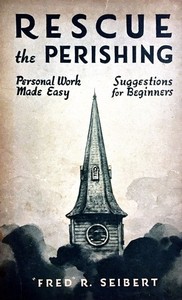
Rescue the Perishing: Personal Work Made Easy — Context and Discussion
(0 User reviews)
50
Project Gutenberg
2016
Not confirmed
Bible -- Indexes
Readers of public-domain and historical texts
Project Gutenberg digital edition
en
Edition facts
Words
41,010
Reading time
179 min
Text sections
110
For Rescue the Perishing: Personal Work Made Easy — Context and Discussion, the stored edition analysis reports 41,010 words, 2 hr 59 min estimated reading time, and 110 detected text sections.
The text analysis averages about 16.0 words per sentence, while the detected sections provide another way to judge how the source is divided.
Project Gutenberg metadata also associates the work with “Bible -- Indexes,” connecting these edition facts with the source record’s subject description.
Source:
Project Gutenberg record #53811
A 1921 manual for Christian evangelism, organized as a topical index of Bible verses and practical advice for personal soul-winning, with sections on assurance, backsliding, excuses, and cottage meetings.
Editorial Edition Score
4.8/5
★★★★★
★★★★★
Calculated from edition completeness, EPUB availability, text structure and catalogue metadata. Not a user rating.
How this score is calculated
- Description quality20 pts
- Title & short description10 pts
- Source metadata20 pts
- Text length15 pts
- Chapters / structure15 pts
- EPUB file integrity20 pts
Total of 100 points, scaled to a 2.5-5.0 range. Editions with an empty description or a missing EPUB file are not scored.
Edition quality
Public-domain source text
Read the source text
The source text is kept in the dedicated reader, separate from this catalogue record and its commentary.
Fred R. Seibert's Rescue the Perishing: Personal Work Made Easy (1921) is structured not as a continuous argument but as a topical index of Bible verses and practical hints for personal evangelism. The table of contents lists over fifty entries—from "Assurance" to "Formalists"—each keyed to a specific spiritual condition or objection. The book's subtitle, "Suggestive Notes and Hints for Beginners in the Christian Life," signals its intended audience: new converts or hesitant Christians needing ready answers. Seibert's preface claims the work was "forged on the anvil of experience," and the excerpts bear this out with concrete, scenario-based advice rather than abstract theology.
A Toolbox of Objections and Replies
The bulk of the book consists of short entries addressing common excuses for not converting. The table of contents alone lists twenty-two distinct excuses, including "I am TOO GREAT a sinner," "I can't give up my EVIL WAYS," and "There are Church members NO BETTER THAN I!" Each entry appears designed to be consulted on the spot, like a reference work. The excerpts show that Seibert pairs each excuse with scriptural counterarguments, often in the form of direct quotations. For instance, the entry on "Excuses. I have no FEELING" likely cites verses about faith rather than emotion. This structure suggests the book was meant to be carried and used in real-time conversations, not read straight through.
The Prayer List and Cottage Meetings
Seibert emphasizes systematic, personal initiative. He advises readers to "make a list of twelve of your acquaintances—very carefully and prayerfully" and to pray for them by name. The section on cottage meetings urges readers to "personally invite those on your list" and to "go with them to the inquiry room, altar or anxious seat." The language is direct and imperative: "Pitch in and do your best." A notable metaphor appears: "Hand-picked fruit always keeps better," implying that converts won early are more stable. The advice also names specific obstacles—"Timidity, Distrust, False Pride, and Fear of Giving Offence"—as "Satan's forces" to be overcome through prayer.
The Soul-Winner's Prayer Sequence
One excerpt outlines a five-step prayer for the personal worker: for "getting up grace" (courage to speak), "walking grace" (daily guidance), direction to the right person, wisdom in words, and power for the message. Each step is supported by a Bible verse—Ephesians 6:15, Proverbs 3:6, Acts 8:29, James 1:5, and Jeremiah 1:17. The sequence reveals a methodical approach to evangelism as a Spirit-led process, not mere technique. Seibert also includes a prayer that God "carry on the work after we are through," acknowledging limits to human effort. This section, like others, blends practical steps with dependence on divine action, reflecting the book's dual emphasis on human initiative and supernatural reliance.
Readers should approach this book as a period artifact of early twentieth-century revivalist methods, not a systematic theology. Its value lies in the concrete scenarios it anticipates and the scriptural responses it assembles. The topical index makes it easy to sample entries relevant to specific questions. Because the excerpts are incomplete, the full range of Seibert's advice—especially on topics like baptism and church membership—remains to be explored in the complete text.
There are no reviews for this eBook.
There are no comments for this eBook.
Reader reflection
How will you remember this book?
Save your reaction, strongest insight, and memorable passage.
Your progress
0
/
10
2
What was your overall reaction to the book?
3
Is this a title you would suggest to others?
4
How much effort did this book require?
5
Did you relate to its people, ideas, or situations?
6
How did the pace of the book feel?
7
Did you gain anything practical from the text?
8
Did any part of the book stay with you emotionally?
9
Which lesson or insight stayed with you?
10