1

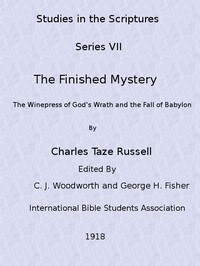
Studies in the Scriptures, Volume 7: The Finished Mystery — Context and Discussion
(0 User reviews)
1002
Project Gutenberg
2014
Not confirmed
Bible -- Criticism, interpretation, etc.; Jehovah's witnesses -- Controversial literature
Readers of public-domain and historical texts
Project Gutenberg digital edition
en
Edition facts
Words
254,896
Reading time
1109 min
Text sections
45
This digital edition of Studies in the Scriptures, Volume 7: The Finished Mystery — Context and Discussion is described by source-level measurements including 254,896 words, 18 hr 29 min estimated reading time, and 45 detected text sections.
The text analysis averages about 18.7 words per sentence, while the detected sections provide another way to judge how the source is divided.
Project Gutenberg metadata also associates the work with “Bible -- Criticism, interpretation, etc.,” connecting these edition facts with the source record’s subject description.
Source:
Project Gutenberg record #46016
This editorial note examines the dense, verse-by-verse commentary style of Russell's posthumous volume, noting its reliance on scriptural citation, historical asides, and a prophetic tone that shifts between exegesis and apocalyptic warning.
Editorial Edition Score
4.9/5
★★★★★
★★★★★
Calculated from edition completeness, EPUB availability, text structure and catalogue metadata. Not a user rating.
How this score is calculated
- Description quality20 pts
- Title & short description10 pts
- Source metadata20 pts
- Text length15 pts
- Chapters / structure15 pts
- EPUB file integrity20 pts
Total of 100 points, scaled to a 2.5-5.0 range. Editions with an empty description or a missing EPUB file are not scored.
Edition quality
Public-domain source text
Read the source text
The source text is kept in the dedicated reader, separate from this catalogue record and its commentary.
The seventh volume of Studies in the Scriptures opens with a subtitle evoking the “Winepress of God’s Wrath” and the fall of Babylon, immediately establishing a tone of impending judgment. The text proceeds as a verse-by-verse exposition of Revelation, interspersed with historical references and doctrinal assertions. The commentary often moves between direct scriptural quotation and explanatory glosses, creating a layered voice that is both instructional and urgent. The editors, C. J. Woodworth and George H. Fisher, note that this work was published posthumously, which may account for its distinctive structure—a compilation of notes and lectures rather than a continuous narrative.
A Commentary Built on Citation
The book’s method is relentlessly citational. Each verse of Revelation is followed by a block of commentary that frequently quotes earlier volumes of the series (e.g., “S. 32,” “F. 611,” “E. 480”). This creates a self-referential network, where the reader is expected to be familiar with Russell’s prior arguments. The voice is that of a teacher who assumes a committed audience, often using phrases like “as we would say” or “it is the Divine arrangement.” The reliance on internal cross-references gives the text a scholarly, almost legalistic feel, but the lack of a single authorial hand—given the posthumous editing—sometimes makes the argument feel disjointed.
Historical Digressions and Prophetic Timelines
Interspersed with the exegesis are historical asides that ground the prophetic text in specific dates and events. For example, the commentary on Revelation 12 mentions the “Times of the Gentiles” ending in October 1914, and includes a lengthy note on the legendary king Lucius Tarquinius Priscus, citing the Britannica. These digressions serve to anchor the symbolic language of Revelation in a concrete historical framework, but they also introduce a shift in pace: the reader moves from dense theological reasoning to a more encyclopedic mode. The effect is a text that oscillates between urgent prophecy and measured historical explanation.
The Rhetoric of Binding and Release
A recurring motif is the binding of Satan and the gradual release of humanity from blindness. The commentary on Revelation 20 emphasizes that the Millennial Kingdom will “first bind Satan” and then “release man from his blindness,” a process that “shall be done gradually and require a thousand years.” This language of binding and release is not merely descriptive but carries a rhetorical charge, framing the present as a period of constraint that will give way to liberation. The voice here becomes more exhortative, using parallelism and repetition to drive home the promise of a future restoration. The shift from analytical commentary to prophetic proclamation marks a distinct change in the text’s emotional register.
Readers approaching this volume should be prepared for a work that demands patience with its cross-referential style and willingness to follow its historical tangents. The book is best read as a companion to the earlier volumes, not as a standalone treatise. Pay attention to the shifts between exegetical explanation and prophetic exhortation—they reveal the text’s dual purpose as both a study aid and a call to readiness.
That afternoon, the rain blurred the window while I traced Russell’s dense margins, feeling the weight of every cited verse pressing toward a single, urgent certainty. Later, restless, I picked up Science and the Infinite; or, Through a Window in the Blank Wall — Edition Insights almost without thinking. Its quiet arithmetic and light-filled proof felt like the same search, but softened—less warning, more whisper.
There are no reviews for this eBook.
There are no comments for this eBook.
Reader reflection
How will you remember this book?
Save your reaction, strongest insight, and memorable passage.
Your progress
0
/
10
2
What was your overall reaction to the book?
3
Is this a title you would suggest to others?
4
How easy was the book to follow?
5
Would you like to discuss this book with someone?
6
How well did it match your expectations?
7
How would you rate its originality?
8
Which aspect of the book did you value most?
9
Which lesson or insight stayed with you?
10