1

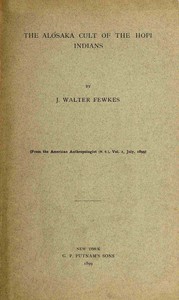
The Alósaka cult of the Hopi Indians — Reading Companion
(0 User reviews)
941
Project Gutenberg
2023
Not confirmed
Hopi Indians -- Religion
Readers of public-domain and historical texts
Project Gutenberg digital edition
en
Edition facts
Words
11,382
Reading time
50 min
Text sections
3
The Alósaka cult of the Hopi Indians — Reading Companion can be approached with a clearer sense of reading commitment from its source measurements: 11,382 words, 50 min estimated reading time, and 3 detected text sections.
The text analysis averages about 27.0 words per sentence, while the detected sections provide another way to judge how the source is divided.
Project Gutenberg metadata also associates the work with “Hopi Indians -- Religion,” connecting these edition facts with the source record’s subject description.
Source:
Project Gutenberg record #70346
An ethnographic study of the Alósaka cult among the Hopi, based on fieldwork and legends, examining its totemic aspects and ritual survivals through horned images and ceremonial societies.
Editorial Edition Score
4.5/5
★★★★★
★★★★★
Calculated from edition completeness, EPUB availability, text structure and catalogue metadata. Not a user rating.
How this score is calculated
- Description quality20 pts
- Title & short description10 pts
- Source metadata20 pts
- Text length15 pts
- Chapters / structure15 pts
- EPUB file integrity20 pts
Total of 100 points, scaled to a 2.5-5.0 range. Editions with an empty description or a missing EPUB file are not scored.
Edition quality
Public-domain source text
Read the source text
The source text is kept in the dedicated reader, separate from this catalogue record and its commentary.
The account opens with a specific incident: in the late 1880s, two wooden idols were removed from a cave near the ruined pueblo of Awatobi, causing consternation among Hopi priests who reclaimed them with a ceremonial trail of meal. This event frames the study as a detective-like inquiry into a living cult, not a relic. Fewkes relies on secondhand sketches and notes from the late A. M. Stephen, as he never saw the images himself, grounding his analysis in reported detail rather than direct observation.
The Horned Images and Their Shrine
The two cottonwood figures, one about four feet tall and the other five inches shorter, are described as having well-carved heads with two straight projections called horns. Stephen’s sketches suggested they represented male and female. Fewkes visited the original shrine—a depression in a large boulder, once walled with masonry, facing east, near the foundation of the old mission church of San Bernardino de Awatobi. The images were never returned to that site; a new, secret fane was established. The narrative emphasizes the physical setting and the objects’ contested history, moving from removal to restoration without resolving their final location.
Legends of Origin and Migration
Fewkes presents multiple, divergent legends. In one, the Alósaka katcina appeared after famine and pestilence, instructing the people to carve wooden images under threat of destruction. Another tells of Alósaka, disguised as a youth, visiting Awatobi from his home in the San Francisco mountains, traveling on the rainbow, and fathering horned children with a maiden. A third legend describes a miraculous virgin birth: father Sun, mother Earth-goddess. The author infers a southern origin for the cult, introduced by a phratry from the Little Colorado region, and expects its most complex survival on the Middle Mesa. The tone remains cautious, noting that these are collected stories, not verified history.
Totemic Parallels Across Societies
Fewkes draws structural comparisons between the Alósaka cult and other Hopi ritual societies. In the Snake-Antelope society, the ancestral pair is called Tcüa-tiyo and Tcüa-mana; in the Flute ceremony, Leñya-tiyo and Leñya-mana; in Lalakonti, Lakone-taka and Lakone-manas; in Mamzrautû, Marau-taka and Marau-manas. Each society personates these figures in secret rites and public dances, often with a boy and a girl or two girls. The Alósaka cult is thus presented as one instance of a widespread totemic ancestor worship, where the male and female Alósakas are ancestors of the Aaltû society, represented by graven images, pictures, or human personators. The analysis is taxonomic, linking specific names and practices without claiming direct descent.
Narrative Voice and Evidentiary Gaps
Fewkes writes in a detached, scholarly tone, frequently qualifying his statements with phrases like “it would seem” or “the result of an examination would seem to be.” He acknowledges that he has not seen the original images, relying on Stephen’s sketches and measurements. The text shifts between firsthand observation (visiting the shrine) and secondhand report (legends from informants). This layered voice creates a sense of careful inference rather than certainty, inviting readers to weigh the evidence themselves. The pace varies: brisk when recounting the removal incident, slower when cataloging parallels across societies.
Readers should attend to how Fewkes navigates between material culture (the images, the shrine) and oral tradition (the legends). His reluctance to claim direct knowledge of the hidden fane or the complete ritual underscores the limits of ethnographic access. The study is best approached as a snapshot of late-nineteenth-century anthropological method, where observation, hearsay, and comparative analysis intertwine.
In the Hopi study, I found a patient watching of horns and ceremonial doors, a people holding old shapes close to the chest. It put me in mind of another quiet record, a year’s walk through dark lands, Through lands that were dark Being a record of a year's missionary journey in Africa and Madagascar — A Reader’s Guide, both simply noting what endures when worlds shift.
There are no reviews for this eBook.
There are no comments for this eBook.
Reader reflection
How did this book work for you?
Your answers remain private and are stored only in this browser.
Your progress
0
/
10
2
Was reading this book enjoyable?
3
Would you recommend this book to another reader?
4
How much effort did this book require?
5
Could you apply anything you learned?
6
How personally connected did you feel to the book?
7
What did you appreciate most?
8
Did the book deliver what you hoped for?
9
In one sentence, what did you learn?
10