1

The Christian Faith Under Modern Searchlights — Story, Setting & Ideas
(0 User reviews)
512
Project Gutenberg
2012
Not confirmed
Modernism (Christian theology)
Readers of public-domain and historical texts
Project Gutenberg digital edition
en
Edition facts
Words
59,566
Reading time
259 min
Text sections
12
This digital edition of The Christian Faith Under Modern Searchlights — Story, Setting & Ideas is described by source-level measurements including 59,566 words, 4 hr 19 min estimated reading time, and 12 detected text sections.
The text analysis averages about 21.8 words per sentence, while the detected sections provide another way to judge how the source is divided.
Project Gutenberg metadata also associates the work with “Modernism (Christian theology),” connecting these edition facts with the source record’s subject description.
Source:
Project Gutenberg record #40060
An editorial note on William Hallock Johnson's 1916 Princeton lectures, examining how the catalog subject 'Modernism (Christian theology)' aligns with the text's engagement with pluralism, theism, and historical criticism, as seen in excerpts on Ward and Royce.
Editorial Edition Score
4.7/5
★★★★★
★★★★★
Calculated from edition completeness, EPUB availability, text structure and catalogue metadata. Not a user rating.
How this score is calculated
- Description quality20 pts
- Title & short description10 pts
- Source metadata20 pts
- Text length15 pts
- Chapters / structure15 pts
- EPUB file integrity20 pts
Total of 100 points, scaled to a 2.5-5.0 range. Editions with an empty description or a missing EPUB file are not scored.
Edition quality
Public-domain source text
Read the source text
The source text is kept in the dedicated reader, separate from this catalogue record and its commentary.
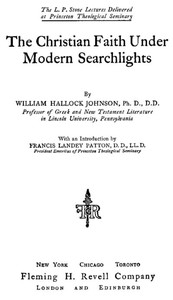
The catalog subject for this volume is 'Modernism (Christian theology),' yet the excerpts suggest a narrower focus: the philosophical defense of supernatural Christianity against naturalism and pantheism. Johnson, a professor of Greek and New Testament Literature, delivers the L. P. Stone Lectures at Princeton Theological Seminary, with an introduction by Francis L. Patton. The text does not survey modernist theology broadly but instead engages specific philosophers—James Ward and Josiah Royce—to argue for theism and immortality. The excerpts show Johnson wrestling with pluralism, the 'revolt from nineteenth century Absolutism,' and the problem of moving from the Many to the One.
Pluralism as a Starting Point
The excerpt from Lecture III reveals Johnson's detailed engagement with James Ward's Realm of Ends. Ward's pluralism begins with 'the many' and seeks a path to 'the one,' a move Johnson presents as a theistic argument. The text states: 'there is an open road from the Many to the One, with sign-posts upon the way.' This phrasing is notable for its metaphor of a journey, not a logical deduction. Johnson notes Ward's rejection of creation ex nihilo in favor of 'intellective intuition,' where God and the world are mutually necessary. The pluralist, as described, is a 'pampsychist' who sees all existence as 'soul-like,' with monads ranging from unconscious to supreme but never inclusive. This philosophical detail is far from a general modernist stance; it is a specific rebuttal to both naturalism and absolute idealism.
The Role of Historical Criticism
Patton's introduction frames the lectures as a response to those 'using the weapons of historical criticism to discredit miraculous Christianity.' Yet the excerpts do not show Johnson engaging historical-critical methods directly. Instead, the text focuses on philosophical arguments. The catalog subject 'Modernism (Christian theology)' might imply a discussion of biblical criticism, but the evidence points to a metaphysical defense. Johnson's own position, stated in the first lecture (not excerpted), is described as 'antagonized by those who hold a naturalistic or pantheistic view of the world.' This suggests the book's core is philosophical apologetics, not historical analysis. Readers expecting a survey of modernist theology may find the text narrower in scope.
Language and Audience
The excerpts show a formal, lecture-style prose with technical philosophical vocabulary: 'singularism,' 'conative and cognitive individuals,' 'intellective intuition.' Johnson assumes an educated audience familiar with Kant, Hegel, and the 'Eleatics.' The text includes untransliterated Greek (e.g., ἀπολύτρωσις) and references to 'the Absolute' as a technical term. This suggests the intended readers are seminary students or clergy with philosophical training. The catalog subject 'Modernism' might attract a broader audience, but the excerpts indicate a specialized, academic treatment. Patton's introduction identifies two groups for whom the lectures may have 'only a moderate interest': those with 'strong and aggressive faith' and those 'easy acquiescence in a minimizing theology,' implying the book targets a middle ground of thoughtful believers.
The catalog subject 'Modernism (Christian theology)' is only partially reflected in the excerpts, which emphasize philosophical theism over historical criticism. Readers should approach the text as a series of lectures on the philosophical defense of supernatural Christianity, engaging thinkers like Ward and Royce. The book does not provide a comprehensive overview of modernist theology but rather a specific argument for theism against pluralism and naturalism. Those interested in early 20th-century apologetics at Princeton will find this volume valuable, but it may not satisfy those seeking a broader treatment of modernism.
Reading Johnson’s lectures, I found myself lingering on how he wrestled with pluralism—that gentle insistence on something lasting beneath so many shifting voices. It reminded me, oddly, of an old plea for apostolic worship I once leafed through, which also sought a steady center amid change. There is a quiet kinship there, I think. Rites and Ritual: A Plea for Apostolic Doctrine and Worship — Background and Themes feels like the same search, offered differently.
There are no reviews for this eBook.
There are no comments for this eBook.
Reader reflection
What did you think of this book?
Answer a few questions and save a private reflection on this device.
Your progress
0
/
10
2
Did this book hold your interest?
3
Would you recommend this book to another reader?
4
Did the language feel accessible?
5
Was the book what you thought it would be?
6
Did it raise ideas you would like to talk about?
7
How did the pace of the book feel?
8
How much did the book move you?
9
What is the main idea you are taking away?
10