1

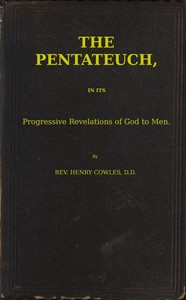
The Pentateuch, in Its Progressive Revelations of God to Men — Text and Context
(0 User reviews)
620
Project Gutenberg
2020
Not confirmed
Bible. Pentateuch -- Criticism, interpretation, etc.
Readers of public-domain and historical texts
Project Gutenberg digital edition
en
Edition facts
Words
166,967
Reading time
726 min
Text sections
21
This digital edition of The Pentateuch, in Its Progressive Revelations of God to Men — Text and Context is described by source-level measurements including 166,967 words, 12 hr 6 min estimated reading time, and 21 detected text sections.
The text analysis averages about 21.6 words per sentence, while the detected sections provide another way to judge how the source is divided.
Project Gutenberg metadata also associates the work with “Bible. Pentateuch -- Criticism, interpretation, etc.,” connecting these edition facts with the source record’s subject description.
Source:
Project Gutenberg record #61241
Henry Cowles examines the Pentateuch topically, tracing God's progressive revelation through structure, recurring imagery, and movement between scenes, with critical engagement with contemporary objections.
Editorial Edition Score
4.9/5
★★★★★
★★★★★
Calculated from edition completeness, EPUB availability, text structure and catalogue metadata. Not a user rating.
How this score is calculated
- Description quality20 pts
- Title & short description10 pts
- Source metadata20 pts
- Text length15 pts
- Chapters / structure15 pts
- EPUB file integrity20 pts
Total of 100 points, scaled to a 2.5-5.0 range. Editions with an empty description or a missing EPUB file are not scored.
Edition quality
Public-domain source text
Read the source text
The source text is kept in the dedicated reader, separate from this catalogue record and its commentary.
Henry Cowles organizes his study of the Pentateuch not by verse-by-verse commentary but by topical arrangement, a choice he defends in the preface as better suited to presenting the “great themes” of these books. This structural decision shapes the entire work: each chapter isolates a single revelation of God—such as his covenant with Abraham, the giving of the law, or the tabernacle instructions—and traces its development across multiple biblical books. Cowles moves deliberately from scene to scene, linking the patriarchal narratives to the exodus events and then to the legal codes, always asking how each stage discloses a fuller picture of the divine character.
Topical Structure as a Lens
Cowles’s topical method means that a single chapter may draw on Genesis, Exodus, Leviticus, Numbers, and Deuteronomy together, rather than treating each book in isolation. For example, his discussion of the “progressive revelations” of God’s holiness weaves together the burning bush, the Sinai theophany, and the tabernacle’s design. This cross-referencing creates a cumulative effect: the reader sees how a motif—such as divine presence or sacrificial atonement—intensifies as the narrative moves from the patriarchs to the wilderness camp. Cowles frequently signals these connections with phrases like “we now advance to” or “the next stage in this revelation,” making the structural logic explicit. The result is a study that prioritizes theological coherence over chronological sequence, though Cowles remains attentive to the historical progression of the Pentateuch’s events.
Recurring Images: Brick, Stone, and Sanctuary
Throughout the excerpts, certain physical images recur. The forced labor of the Hebrews—making brick for Pharaoh’s treasure cities—is juxtaposed with the later construction of the tabernacle, where skilled artisans fashion gold, silver, and acacia wood for a dwelling place for God. Cowles draws on Egyptian records to corroborate the severity of the brick-making, citing a papyrus that mentions “Aperiu who carry stone for the great Bekhen.” This attention to material detail grounds the exodus story in tangible labor. The contrast between the brick kilns of Egypt and the sanctuary of the wilderness is not stated explicitly but emerges from the arrangement of topics: the same people who groaned under taskmasters later contribute freewill offerings for a tent of meeting. Cowles’s method invites the reader to see these images as bookends of a single redemptive movement.
Movement Between Scenes: From Egypt to Sinai
Cowles structures his chapters to follow the Pentateuch’s geographical and narrative movement. He begins with the patriarchal sojourn in Canaan, then shifts to Egypt, then to the exodus, and finally to Sinai and the wilderness. Each transition is marked by a change in the mode of revelation: to Abraham, God speaks in promises and visions; to Moses, in a burning bush and plagues; to Israel at Sinai, in thunder and a written law. Cowles emphasizes that these shifts are not arbitrary but pedagogical—God adapts his self-disclosure to the people’s capacity and circumstances. The movement from the personal call of Abram to the national covenant at Sinai illustrates a broadening of the divine audience. Cowles’s commentary on the plagues, for instance, treats them not merely as judgments but as staged demonstrations of Yahweh’s power over Egyptian deities, each plague targeting a specific aspect of the natural world that Egypt deified.
Critical Engagement with Contemporary Objections
Cowles devotes significant space to addressing “modern objections to Genesis, more or less related to true science,” as he states in the preface. He examines the Shepherd King (Hyksos) hypothesis, the identification of the “Aperiu” with the Hebrews, and the chronology of the exodus. His approach is to weigh evidence from Egyptian monuments and papyri, citing scholars like Chabas and Rawlinson, while maintaining that the biblical account is historically reliable. He does not dismiss scientific findings but insists that “all real truth be welcomed and held in honor.” This critical engagement is woven into the topical structure: when discussing the plagues or the Red Sea crossing, he notes that Egyptian records would not be expected to record such disasters, as they were “consecrated to the triumphs and glories of the kingdom.” This argument from silence is characteristic of Cowles’s method—he uses external evidence to corroborate the biblical narrative where possible, and explains its absence where not.
Readers approaching Cowles’s work will benefit from following his topical organization rather than jumping to a single book. The index and table of contents guide one to specific themes—such as “the covenant with Abraham” or “the law of Moses”—but the cumulative argument depends on reading the chapters in sequence. Cowles assumes familiarity with the biblical text and does not retell the stories in full; his focus is on the theological significance of each episode and its place in the progressive revelation. For those interested in nineteenth-century responses to higher criticism and archaeological discoveries, this volume offers a thoughtful, conservative perspective that engages seriously with the evidence of its day.
Reading about Cowles tracing God’s slow unveiling through the Pentateuch stirred a memory of sitting on my porch as a teenager, underlining passages in The Purpose of the Papacy — Themes and Context, feeling that same quiet sense of something unfolding patiently, not all at once, but always with a hidden coherence.
There are no reviews for this eBook.
There are no comments for this eBook.
Reader reflection
How will you remember this book?
Save your reaction, strongest insight, and memorable passage.
Your progress
0
/
10
2
How did the book work for you overall?
3
How likely are you to recommend this book?
4
What was the reading difficulty like?
5
How would you describe its reading pace?
6
How well did it match your expectations?
7
How would you rate its originality?
8
Did you gain anything practical from the text?
9
In one sentence, what did you learn?
10