1

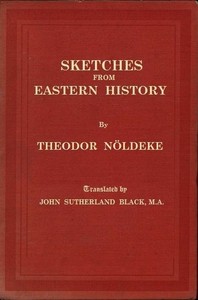
Sketches from Eastern History — Themes and Context
(0 User reviews)
48
Project Gutenberg
2017
Not confirmed
Christian saints; Theodore II, Negus of Ethiopia, -1868; Islam; Islamic Empire; Bar Hebraeus, 1226-1286; Semites; Syria -- Church history
Readers of public-domain and historical texts
Project Gutenberg digital edition
en
Edition facts
Words
95,358
Reading time
415 min
Text sections
11
For Sketches from Eastern History — Themes and Context, the stored edition analysis reports 95,358 words, 6 hr 55 min estimated reading time, and 11 detected text sections.
The text analysis averages about 26.2 words per sentence, while the detected sections provide another way to judge how the source is divided.
Project Gutenberg metadata also associates the work with “Christian saints,” connecting these edition facts with the source record’s subject description.
Source:
Project Gutenberg record #54782
Theodor Nöldeke's collection of historical essays examines the rise of Islam, the Abbasid caliphate, and figures like Bar Hebraeus and King Theodore of Abyssinia, with a focus on political and religious dynamics in the medieval Near East.
Editorial Edition Score
4.8/5
★★★★★
★★★★★
Calculated from edition completeness, EPUB availability, text structure and catalogue metadata. Not a user rating.
How this score is calculated
- Description quality20 pts
- Title & short description10 pts
- Source metadata20 pts
- Text length15 pts
- Chapters / structure15 pts
- EPUB file integrity20 pts
Total of 100 points, scaled to a 2.5-5.0 range. Editions with an empty description or a missing EPUB file are not scored.
Edition quality
Public-domain source text
Read the source text
The source text is kept in the dedicated reader, separate from this catalogue record and its commentary.
Theodor Nöldeke's Sketches from Eastern History opens with a preface that reveals the book's composite nature: three essays previously appeared in German periodicals, one formed part of an Encyclopædia Britannica article, and the rest were written in the preceding year. The author acknowledges using August Müller's History of Islam as a supplement, particularly for the second, third, fourth, fifth, and sixth essays. This transparency about the work's origins prepares the reader for a collection that moves between specialized scholarship and accessible narrative, with Nöldeke aiming to 'obliterate the traces of laborious study' while retaining value for specialists.
The Author's Method and Sources
Nöldeke's preface offers a candid view of his scholarly habits. He notes that he has 'made careful use of all the sources that were accessible' but cites them 'only rarely,' a choice that prioritizes readability over exhaustive footnoting. The translator, J. Sutherland Black, revised the text with the author's input, and the preface thanks colleagues like De Goeje and G. Hoffmann for geographical assistance. Nöldeke also explains his retention of classical place names (e.g., Babylonia for Irák) for convenience, and his method for reconciling conflicting Islamic dates by holding to the day of the week. These details signal a work aimed at an educated but non-specialist audience, where clarity trumps pedantry.
The Collapse of the Abbasid Empire
The essay 'A Servile War in the East' begins with a vivid depiction of the Abbasid empire's decline after Caliph Mutawakkil's murder in 861. Nöldeke describes how 'the troops, Turkish and others, raised and deposed the Caliphs,' and how generals—often former slaves—vied for power. This context sets the stage for the rise of Alí ibn Mohammed, a self-proclaimed descendant of the Prophet who exploited the chaos. Nöldeke's phrasing is precise: Alí 'gave himself out to be a descendant of Alí and of his wife Fátima,' but the author notes the claim 'may have been just' or 'a mere invention.' The essay grounds Alí's ambitions in specific geography—the village of Verzenín near Teherán—and traces his early failures in Basra before his eventual success.
The Role of Marginalized Groups
Nöldeke emphasizes that Alí's rebellion relied on 'the most despised class of the population,' a strategic choice that made his movement both threatening and resilient. The author highlights the involvement of a 'black freedman, Sulaimán, son of Jámi,' as one of Alí's most capable generals, and notes that several key followers came from the remote district of Bahrein. This attention to social dynamics—rather than mere military chronology—gives the essay its analytical depth. Nöldeke also observes that the rebellion lasted 'nearly fourteen years,' requiring sustained effort from a caliphate that had 'recovered a little of its former strength.' The narrative thus intertwines political instability with the agency of marginalized groups, a theme that recurs across the collection.
Comparative and Critical Notes
Throughout the excerpts, Nöldeke inserts comparative remarks that reveal his broader historical perspective. In a footnote, he cites Lucretius's line 'Tantum relligio potuit suadere malorum' to comment on 'the misery yet destined to come upon the world through the aggressiveness of Semitic religious zeal.' He also compares anecdotes to the 'pseudo-Aristotelic Oeconomica' and notes that 'at sea the great Arab dynasties, like the Roman, have seldom done anything considerable.' These asides, while brief, show Nöldeke's willingness to draw parallels across cultures and eras. The preface's closing remark—that he does not mean 'that we Europeans live in a political Paradise'—further signals a critical, self-aware stance that enriches the historical analysis.
Readers approaching Sketches from Eastern History should treat each essay as a self-contained study, but the preface and footnotes provide a connective thread. Nöldeke's habit of embedding critical commentary in endnotes—often with sharp observations—rewards careful attention. The work is best read with a map of the medieval Near East at hand, as the author frequently shifts between regions and dynasties. For those new to Islamic history, the essays on the Koran and the Abbasids offer a solid entry point, while the later pieces on Bar Hebraeus and King Theodore of Abyssinia broaden the scope beyond the Arab world.
Reading Nöldeke’s portraits of distant caliphs and scholars, I felt that ache of watching vast systems of belief harden into politics. It made me think of another old book, The Idea of God as Affected by Modern Knowledge — A Closer Reading, which quietly wonders how our own certainties are shifting beneath us, just as those did.
There are no reviews for this eBook.
There are no comments for this eBook.
Reader reflection
What did you think of this book?
Answer a few questions and save a private reflection on this device.
Your progress
0
/
10
2
How did the book work for you overall?
3
Would you recommend this book to another reader?
4
What was the reading difficulty like?
5
Did any part of the book stay with you emotionally?
6
Could you see yourself revisiting this book?
7
How well did it match your expectations?
8
Was the book easy to understand?
9
Which lesson or insight stayed with you?
10