1

The Idea of God as Affected by Modern Knowledge — A Closer Reading
(0 User reviews)
505
Project Gutenberg
2014
Not confirmed
God (Christianity)
Readers of public-domain and historical texts
Project Gutenberg digital edition
en
Edition facts
Words
33,091
Reading time
144 min
Text sections
5
The catalog record for The Idea of God as Affected by Modern Knowledge — A Closer Reading provides practical reading context through 33,091 words, 2 hr 24 min estimated reading time, and 5 detected text sections.
The text analysis averages about 26.8 words per sentence, while the detected sections provide another way to judge how the source is divided.
Project Gutenberg metadata also associates the work with “God (Christianity),” connecting these edition facts with the source record’s subject description.
Source:
Project Gutenberg record #46476
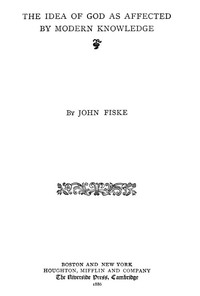
John Fiske's 1885 address argues that modern evolutionary science, far from undermining theism, compels a revision of the idea of God—rejecting the antithesis between divine action and natural law in favor of an ever-present God identified with orderly natural processes.
Editorial Edition Score
4.7/5
★★★★★
★★★★★
Calculated from edition completeness, EPUB availability, text structure and catalogue metadata. Not a user rating.
How this score is calculated
- Description quality20 pts
- Title & short description10 pts
- Source metadata20 pts
- Text length15 pts
- Chapters / structure15 pts
- EPUB file integrity20 pts
Total of 100 points, scaled to a 2.5-5.0 range. Editions with an empty description or a missing EPUB file are not scored.
Edition quality
Public-domain source text
Read the source text
The source text is kept in the dedicated reader, separate from this catalogue record and its commentary.
John Fiske opens this 1885 address by stating his aim to review how the idea of God has been modified through history and to outline the conception likely to be held by minds trained in the doctrine of evolution. The work is a sequel to his earlier The Destiny of Man and was delivered before the Concord School of Philosophy. Fiske explicitly frames his argument as a response to the question whether pantheism is the legitimate outcome of modern science, though he declines to settle the label, calling it a “vague and uninstructive epithet.”
The Antithesis Between Divine Action and Natural Law
Fiske identifies a persistent habit of thought that divides nature into two provinces: phenomena occurring with simple regularity, deemed the realm of natural law, and complex, irregular phenomena, assigned to immediate divine action. He traces this antithesis to “the lower or Augustinian theism” and argues that it has made theologians hostile to science and scientists hostile to theology. Each scientific discovery, he writes, has “stripped off territory” from the province of divine action, leading to a centuries-long conflict in which science has won every disputed position. The ordinary theologian, Fiske contends, still rests his case on “the assumption of disorder, caprice, and miraculous interference.”
The Higher Theism of Clement and Athanasius
Fiske contrasts the Augustinian tradition with what he calls “the higher theism of Clement and Athanasius.” Adopting this conception, he asserts, makes the alleged antagonism between science and theology vanish. He writes that once one adopts the idea of “an ever-present God, without whom not a sparrow falls to the ground,” it becomes self-evident that the law of gravitation is “an expression of a particular mode of divine action.” For such a thinker, every extension of knowledge brings fresh confirmation of faith, and no part of the universe is godless. Fiske’s language here is notably concrete: he lists “the swaying to and fro of molecules,” “the secular shiftings of planetary orbits,” and “the mysterious sprouting of the seed” as arenas of divine activity.
The Theologian’s Question and Fiske’s Reply
Fiske quotes a hypothetical theologian who asks, if plants and animals have been naturally originated and the world evolved, “what is there left for God to do?” The scientific inquirer, Fiske responds, may reply that the difficulty is one theology has created for itself. He insists that it is not science that has relegated divine activity to a bygone eternity or left God without occupation in the present world. The mischievous distinction between divine action and natural law, he argues, is historically derived from “a loose habit of philosophizing characteristic of ignorant ages” and bequeathed by the Latin church. Fiske goes so far as to say that an atheist starting from such a basis is doing “as well as he knows how, with the materials given him.”
Fiske’s argument is tightly focused on reconciling evolutionary science with a revised theism, but the excerpts offer only his opening framework and a central section. Readers should note that the full text likely develops the historical review of modifications to the idea of God and may address the pantheism question more directly. The work is best approached as a philosophical lecture, not a systematic treatise, and its force depends on Fiske’s rhetorical contrasts between competing theological traditions.
I recall evenings shelving Fiske, how he found God not apart from nature’s grind but within its very order. That same quiet insistence—faith surviving honest scrutiny—returns in The Christian Faith Under Modern Searchlights — Story, Setting & Ideas. Two voices, decades apart, yet sharing one gentle conviction: the light of inquiry need not extinguish the old lamps. A kinship worth remembering.
There are no reviews for this eBook.
There are no comments for this eBook.
Reader reflection
What did you think of this book?
Answer a few questions and save a private reflection on this device.
Your progress
0
/
10
2
How did the book work for you overall?
3
Is this a title you would suggest to others?
4
Did the language feel accessible?
5
How clearly were the main ideas presented?
6
Did the book offer a fresh perspective?
7
Could you apply anything you learned?
8
Would you read this book again?
9
What did this book teach you most?
10